
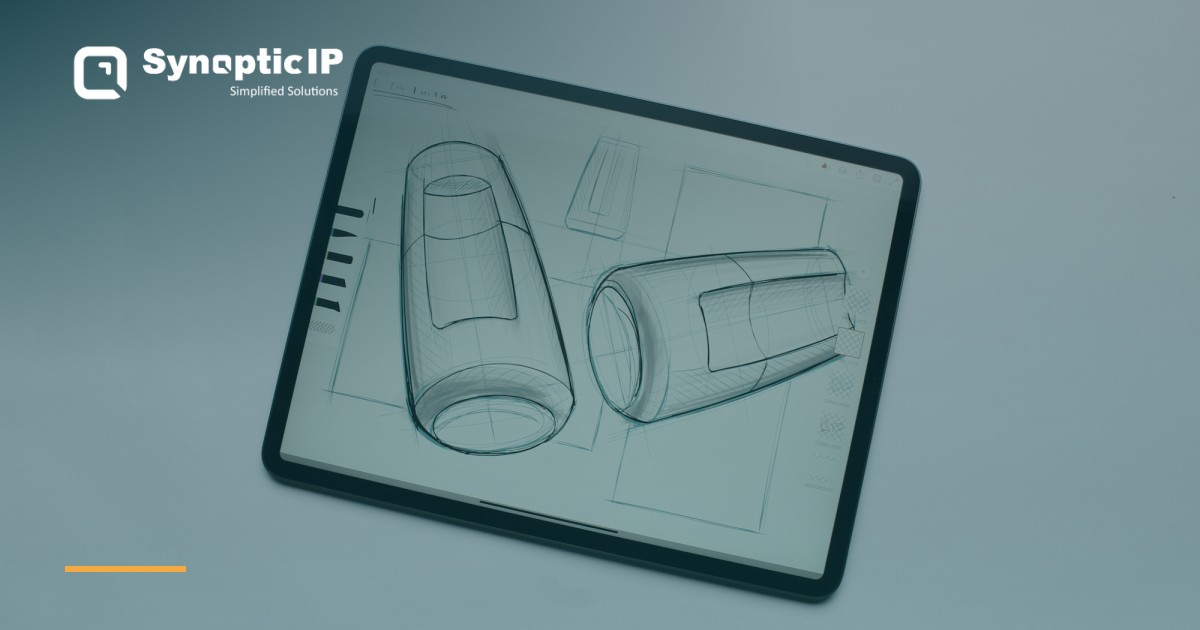
Design patent drawings are the figures that show the appearance of an ornamental design, and in a United States design application they define what is claimed. The claim refers to the design “as shown”, so the views, the shading and the choice between solid and broken lines set the scope of protection. A design patent drawings service prepares these figures to United States Patent and Trademark Office (USPTO) rules.
What design patent drawings must show
Design patent drawings must show the full appearance of the claimed design, with no reliance on words. Under the Code of Federal Regulations at 37 CFR 1.152, the drawing must contain “a sufficient number of views to constitute a complete disclosure of the appearance of the design”.
35 U.S.C. 171 of the United States Code protects a new, original and ornamental design for an article of manufacture. Practice is set out in Manual of Patent Examining Procedure (MPEP) 1503.02, and the general rules in the USPTO patent drawing rules checklist also apply.
Design patent views: the standard set
The MPEP lists front, rear, top, bottom and side views and suggests perspective views, so a typical set has 7 views:
- front and rear views
- left side and right side views
- top and bottom views
- a perspective view
Views are numbered FIG. 1, FIG. 2 and so on under 37 CFR 1.84(u), and a view can be omitted when the specification makes the reason clear.
| Situation | Usual approach | Statement in the description |
|---|---|---|
| One side mirrors the other | Show one side only | The other side is identical or a mirror image |
| Flat, plain bottom | Omit the bottom view | The bottom is flat and devoid of surface ornamentation |
When views do not match, the examiner objects to the drawings. Where the appearance is unclear as a result, the claim can be rejected as nonenabling and indefinite under 35 U.S.C. 112(a) and (b).
Surface shading and stippling
Surface shading shows contour, so that a flat panel and a curved panel do not look the same. Rule 1.152 calls for “appropriate and adequate surface shading” and bars solid black shading except to show the colour black or colour contrast.
The USPTO names straight line shading and stippling, a pattern of fine dots, as common methods, and by convention stippling is often used on curved surfaces. Under 37 CFR 1.84(m), shading lines must be thin and as few as practicable, with light coming from the upper left at 45 degrees.
The MPEP warns that missing shading at filing may make the design nonenabling and indefinite, and that shading added later may be new matter.
Broken lines in design patent drawings
Broken lines show what is not claimed, mainly environmental structure or the boundary of the claimed area. The description states that this subject matter forms no part of the claimed design.
Several limits apply:
- broken lines may show visible environment, but not hidden planes behind opaque material
- they should not cross or intrude on the claimed design
- they cannot mark a portion of the article as less important
- alternate positions in full and broken lines in one view are not permitted
The choice between solid and broken lines is therefore a claim drafting decision. Depending on the prior art, claiming only the part a competitor is likely to copy can be harder to design around.
Sectional views and photographs
A sectional view can clarify a shape. A section presented only to show internal construction is unnecessary and may cause confusion about the claim scope.
Photographs are accepted only when they are the only practicable medium (37 CFR 1.84(b)). They cannot be mixed with ink drawings in one application or show environmental structure.
Why design drawing sets go wrong
Defects often come from treating the figures as illustrations rather than as a claim. An illustrator working only from the product may shade a surface in one view and not another, and the new matter rule makes such errors hard to fix.
The following example is an illustration and does not describe a real project. A kitchen tap is drawn in solid lines throughout, although the attorney wanted to claim only the spout. Converting the body to broken lines later depends on support in the original drawings, and a new boundary line may be treated as new matter.
A sound workflow for a design drawing team runs in 4 steps:
- The attorney marks the claimed portion.
- The illustrator drafts every view with consistent shading.
- A second person cross-checks the views.
- The figure descriptions and omission statements are written to match.
Later objections are covered in this guide to responding to a drawing objection.
Ordering design patent drawings
We prepare formal design patent drawings to USPTO rules. Our design patent drawings page explains the service and how to order.
This guide is general information and is not legal advice.
Frequently Asked Questions
How is a design patent claim worded?
A design patent has a single claim to the ornamental design for the named article “as shown”, or “as shown and described”, under 37 CFR 1.153. More than one claim is not permitted. The title names the article, and the drawings define the scope.
Can design patent drawings be changed after filing?
Yes, but only within what the original drawings support. An amendment may not add new matter, so new shading or a new non-straight boundary line can be refused. Reducing part of the design to broken lines is permitted where the application shows possession of the narrower design.
Is a perspective view required in a design patent?
No. The MPEP suggests perspective views for three-dimensional designs but does not require them. A perspective view is still common, because it shows depth in a way that flat views cannot, and its shading must agree with the other views.
What paper size and margins do design patent drawings use?
Design patent drawings use sheets of 21.0 x 29.7 cm (A4) or 21.6 x 27.9 cm under 37 CFR 1.84(f). Under 1.84(g), the minimum margins are 2.5 cm at the top and left, 1.5 cm at the right and 1.0 cm at the bottom.
How long does a US design patent last?
A US design patent filed on or after 13 May 2015 lasts 15 years from the date of grant under 35 U.S.C. 173, and earlier filings have 14 years. No maintenance fees are payable under 35 U.S.C. 41(b)(3), so a drawing error affects protection for the whole term.
Filed under