
Novelty & Patentability Search
A Synoptic IP patentability search goes beyond confirming novelty — it delivers the prior art intelligence you need to define a scope of protection that is worth filing for and worth enforcing.
Our engineering team operates on a hybrid methodology that pairs rigorous human analysis with AI-assisted patent search tooling. The result: a prior art search service that surfaces the most relevant references with precision, on schedule, and at a cost that makes commercial sense.
- 4,000+novelty searches
- 70+clients
- 12+years in practice
- 6 yrsaverage engineer experience
How a Patentability Search Works
The reason for ordering a prior art search varies from client to client, which is why every novelty search we conduct is scoped precisely to the brief. A patentability search delivers the closest prior art references alongside our analysis and a detailed element-by-element mapping. The resulting report gives you a firm basis for setting or refining the scope of your claims — and gives your R&D team a clear picture of where the state of the art currently stands.
Why Do You Need a Patentability Search?
Can I get a patent for my invention?
Before committing resources to patent filing preparation and prosecution, it is essential to establish whether the subject matter is patentable in the first place. A professional patentability search answers that question early — and prevents significant investment from flowing into an application that was never viable.
Write the best possible claims
A well-informed prior art search helps you calibrate claim scope with precision — broad enough to deliver meaningful commercial protection, yet narrow enough to survive prosecution without burning through budget on unnecessary office action responses.
Shorter prosecution
Knowing the landscape before you file means fewer surprises during examination. Anticipating the prior art an examiner is likely to cite allows you to draft around it, compress the prosecution cycle, and reduce the number of office action responses needed to reach allowance.
Improve the design or the invention
Benchmarking an invention against existing art gives R&D a precise read on the technical white space available to them — and gives the drafter the grounding to make well-reasoned decisions on claim scope and specification strategy.
Save time and overall spend
Patent attorneys who work from a thorough patent search rather than drafting a patent application cold save meaningful time on preparation — and avoid committing the firm’s and the client’s resources to applications that cannot succeed on the merits.
Understand what the patent is worth
A patentability search maps what competitors are actively developing and positions the invention relative to that activity — intelligence that feeds directly into commercial and licensing strategy, well beyond the initial filing decision.
Why Choose Synoptic IP as Your Patent Search Service
- A process built to scale — equally suited to bulk search programmes for large corporate IP departments and individual project requests from law firms, SMEs, and independent inventors.
- A thorough intake methodology that captures the full technical scope of the invention while placing minimal administrative burden on inventors and their counsel.
- Accurate, well-reasoned prior art search reports structured for fast review — written to be read by practitioners, not decoded by them.
- Analytical insight and substantive technical input that supports confident, informed decisions on patentability and claim strategy.
- An award-winning patent search service with over twelve years of continuous operation as a trusted patentability search provider to law firms and corporations worldwide.
How We Present the Results
Smart Mapping
A concise, multi-dimensional comparison of the invention’s key features against the prior art we identified — designed to give you a rapid read on where you stand before diving into the detail.
Comprehensive Mapping
A complete feature-by-feature analysis of the invention measured against all relevant prior art, element by element, with substantive expert commentary at each point of comparison.
Highlighted Documents
For every reference identified, we supply the full text with all pertinent passages underlined and colour-coded by relevance — so you can independently verify our analysis and cite directly to the source.
Words From Our Clients
Verified LinkedIn reviews and client correspondence from patent attorneys and in-house IP teams who come back to us project after project.

I used Synoptic for a validity search and was pleased with the results. The rates were highly competitive, the deliverable was on time, and the results were as good as (if not better than) other searches I’ve used.
 Erin J. FoxIntellectual Property Counsel · ITW
Thank you — the search was quite helpful. We’ll have your invoice processed promptly.

Thank you for your work on this matter. We were pleased with the search and will consider you for future searches.

We were very pleased with the patentability and FTO report that you produced for us back in November 2024.
Frequently Asked Questions
What is a patentability search?
A patentability search — also called a novelty search or prior art search — is a structured investigation of both patent and non-patent literature to identify existing disclosures relevant to a claimed invention. The outcome gives the inventor and their counsel a well-grounded view on whether the invention is novel and non-obvious, and therefore worth pursuing to grant.
Who should run a patentability search?
Anyone weighing a patent filing decision. A professional patentability search gives applicants the information they need to decide whether to proceed — and can save considerable time, money, and professional resource by identifying inventions that do not meet the threshold for patent protection before any application is filed.
How much does a professional patentability search cost?
Patent search cost varies with the technical complexity of the invention and the depth of search required. A professional patentability search typically ranges from $150 to $1,200, with most standard novelty searches sitting comfortably within the mid-range of that band. The cost of a prior art search is almost always a fraction of what you would spend discovering the same information during prosecution.
| Invention complexity | Typical cost range | Typical turnaround |
|---|---|---|
| Quick novelty search | $150 – $450 | 2 – 4 business days |
| Standard electrical, software, or consumer product | $450 – $750 | 4 – 6 business days |
| Complex, multi-feature, or emerging-technology invention | $750 – $1,200 | 6 – 10 business days |
How is a patentability search performed?
A patentability search can be conducted by a specialist prior art search firm, by patent counsel, by the inventor directly, or by an independent search expert. In practice, searches draw on multiple patent databases — using keyword queries, CPC classification codes, and citation analysis of the most relevant references — alongside non-patent literature sources where the technology warrants it. There are several patent search types suited to different objectives: a novelty search establishes whether an invention is patentable before filing; other search types address different questions at different stages of the patent lifecycle.
| Search type | Question it answers | When to use it |
|---|---|---|
| Novelty / Patentability Search | Is this invention new and non-obvious? | Before filing a patent application |
| Patent Invalidity Search | Can an existing granted patent be challenged or invalidated? | Defending against an infringement claim, or clearing a blocking patent |
| Freedom-to-Operate (FTO) Search | Will launching this product infringe someone else’s patent? | Before commercial launch or manufacturing |
| Patent Landscape Analysis | What does the competitive patent activity look like in this space? | R&D planning, investment due diligence, or market entry strategy |
Can a patentability search be skipped before filing?
It is not advisable. Searching before filing a patent serves two distinct purposes: it helps identify prior art that a product may need to design around, and it avoids committing legal fees, filing costs, and management time to an application the prior art will ultimately defeat. The patent search cost is almost always a fraction of the cost of learning the same information during prosecution.
What is meant by “patent information”?
Patent information is the body of technical and legal data published in patent applications and granted patents. It encompasses bibliographic details — applicant, inventor, filing dates, designated territories, and legal status — as well as the full technical disclosure of the invention, related prior art cited during examination, and the claims that define the legal scope of protection. Because patents must fully disclose the invention in exchange for exclusive rights, the patent literature as a whole constitutes one of the largest bodies of publicly available technical knowledge across virtually every field of technology.
Why does knowledge of patents matter?
Patent documents contain technical and commercial information that is frequently published nowhere else. By some estimates, up to 90% of new technical knowledge enters the public domain for the first time through patent publications. That makes the patent literature an indispensable resource for businesses, inventors, and researchers who need to:
- Assess the state of the art in a field, identify recent technical advances, and pinpoint growth areas before they become crowded.
- Improve existing products or processes by building on what has already been disclosed and what has not been claimed.
- Identify patent-protected technology in order to evaluate licensing or design-around options.
- Eliminate duplication of R&D effort and direct resources toward genuinely novel development.
- Assess the patentability of a new invention before committing to prosecution.
- Identify early-stage market niches and track emerging technology trends ahead of competitors.
- Monitor the patent activity of partners and rivals, and identify potential M&A, licensing, or joint development opportunities.
Where can I find information on patents?
National and regional patent offices typically publish patent applications 18 months after the earliest priority date, and granted patents upon issuance. Most offices make their records available through free online databases. WIPO’s PATENTSCOPE provides access to national and regional office collections — including those of the EPO and USPTO — alongside PCT international applications. Espacenet is accessible through the EPO, and offices in China (CNIPA), Japan (J-PlatPat), and Korea (KIPRIS) each operate their own free portals. For broader intellectual property searches, lens.org and Google Patents offer free access to large multi-jurisdiction collections. The information is publicly available; using it effectively, however, requires analytical skill — for decisions with material consequences, a professional patent search service adds significant value.
Are there better sources than the free databases?
Yes. Beyond the free databases, commercial platforms such as Derwent Innovation, LexisNexis PatentAdvisor, PatBase, and Questel offer enhanced patent searching functionality, richer analytics, and fuller family and legal status data. National patent offices also offer direct expert patent search services. For organisations that need consistent search quality, structured reporting, and technical analytical input, engaging a specialist prior art search firm such as Synoptic IP is typically the most efficient and cost-effective route.
What is a patent?
A patent is a time-limited exclusive right granted by a patent office in exchange for full public disclosure of an invention. To qualify, the invention must be new, involve an inventive step, and be capable of industrial application. The patent confers on the holder the right to prevent others from making, using, selling, or importing the patented invention without authorisation — typically for a period of twenty years from the filing date, subject to maintenance fees. Intellectual property more broadly encompasses all creations of the human intellect: inventions, literary and artistic works, designs, trade marks, and related rights.
How do I apply for a patent?
An application is filed with the patent office of the relevant jurisdiction — ordinarily the applicant’s home country or the country in which the invention was made — and takes the form of either a provisional specification or a complete specification. A provisional filing secures a priority date without requiring the full disclosure; the complete specification must then be filed within 12 months, with no extension available. International patent protection can be pursued through a PCT application, which must be filed within 12 months of the first filing date and allows entry into over 150 national and regional phase jurisdictions.
What is patentable, and what is not?
Patent protection is available for a wide range of technological innovations — new plant varieties, manufacturing processes, machines, tools, chemical compositions, improvements on existing inventions, and advanced materials including nanotechnology. Eligibility requirements and exclusions vary by jurisdiction, but the table below summarises the general position.
| Generally patentable | Generally NOT patentable |
|---|---|
| New plant varieties | Mere ideas without a concrete enabling disclosure |
| Manufacturing processes and production methods | Inventions contrary to established natural laws |
| Machines, tools, and devices | Mathematical equations and abstract formulae |
| Chemical compositions and formulations | Discoveries of scientific principles or naturally occurring substances |
| Improvements to existing inventions | Laws of nature and mathematical relationships as such |
| Advanced materials, including nanotechnology | New species or organisms with no inventive technical contribution |
| Inventions relating to atomic energy, in most jurisdictions | |
| Methods of medical treatment, horticulture, or agriculture (jurisdiction-dependent) | |
| Algorithms, computer programs as such, and business methods | |
| New forms or uses of known compounds with no enhanced efficacy |
What role do patents play in my business?
Patents serve multiple strategic and commercial functions:
- Competitive exclusivity — a granted patent prevents competitors from exploiting the patented invention without a licence, creating a defensible market position and supporting premium pricing.
- Balance sheet value — intangible assets, including IP, now account for an estimated 70 to 80 per cent of the market capitalisation of many businesses. A patent portfolio carries value independent of the underlying product’s commercial performance and can be licensed or monetised even where the product itself does not succeed.
- Revenue diversification — patents can be licensed to businesses operating in territories or market segments the patent holder does not serve directly, generating royalty income without additional capital deployment.
- Reduced litigation exposure — a meaningful patent portfolio creates cross-licensing opportunities and deters third-party infringement claims, reducing overall IP dispute risk.
What happens if I do not file?
Where an invention has genuine commercial value, failing to patent it — or delaying the filing decision — carries material risk:
- Competitors are free to adopt and commercialise the invention, and once one does, others typically follow without restriction.
- Larger, better-resourced manufacturers can replicate the invention at scale and undercut the original innovator on price in their own market.
- Smaller competitors, unburdened by the original R&D investment, can also enter and compete on cost.
- Without patent protection, the technology is substantially harder to sell, licence, or transfer — limiting its value as a strategic asset.
If an employee invents something, who owns the patent?
Where an invention arises in the course of employment — particularly where the employee was hired to invent or the invention falls within the scope of their duties — the patent rights generally vest in the employer as a matter of law. Most organisations reinforce this with express IP assignment clauses in employment contracts to remove any ambiguity. The inventor, however, retains certain rights regardless of ownership: they cannot be removed as the named inventor on the patent, and depending on the jurisdiction and contractual terms, may be entitled to compensation where the invention proves to be of exceptional commercial value.
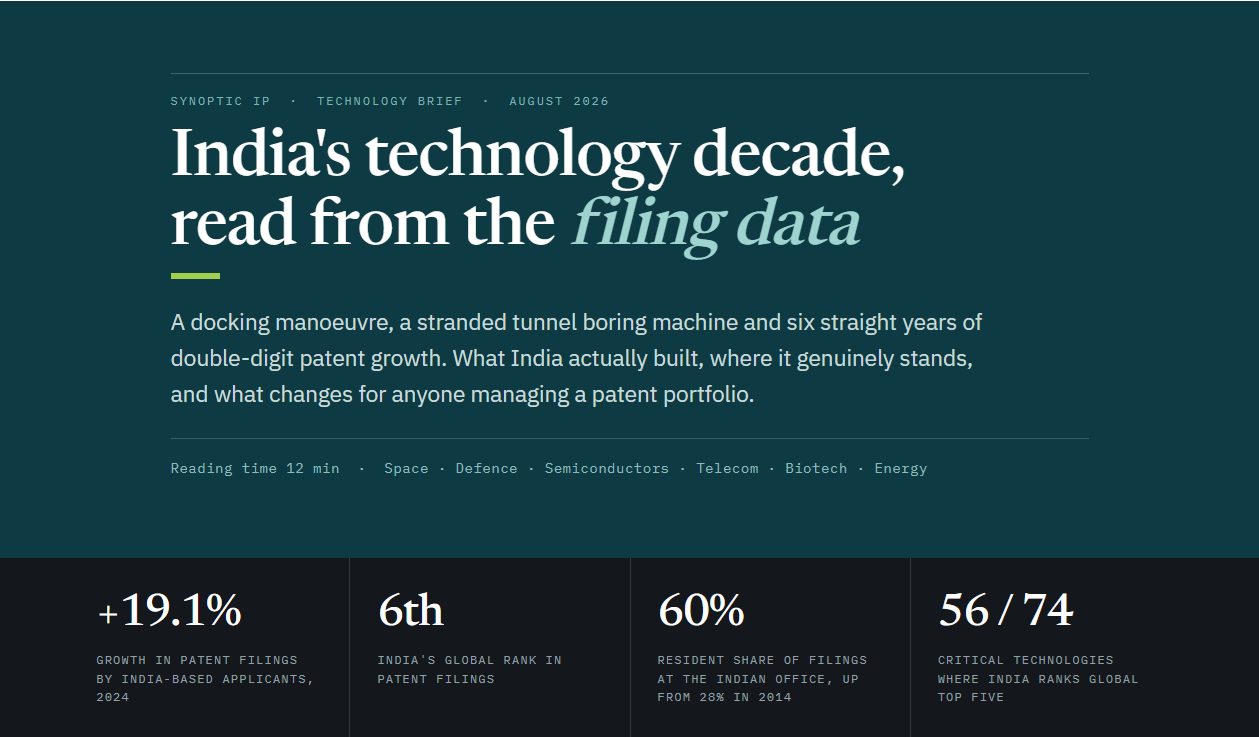
India’s technology decade, read from the filing data
A docking manoeuvre, a stranded tunnel boring machine and six straight years of double-digit patent growth. What India actually built, where it genuinely stands, and what changes for anyone managing a patent portfolio.
Read Full Article
The Next Wave of Neuromodulation
Neuromodulation used to be a quiet corner of medtech — a handful of chronic-pain and movement-disorder devices, slow-moving and predictable. That is no longer true, and the patent landscape shows exactly where the next generation of advantage is being built.
Read Full Article
A Guide to Markush Structure Patent Search and Analysis
Imagine a picture representing not just a single molecule, but an entire family of related compound markush structure search. This is the essence of the Markush structure. It uses variables and wildcards to include a diverse set of molecules that share a common core structure.
Read Full Article