
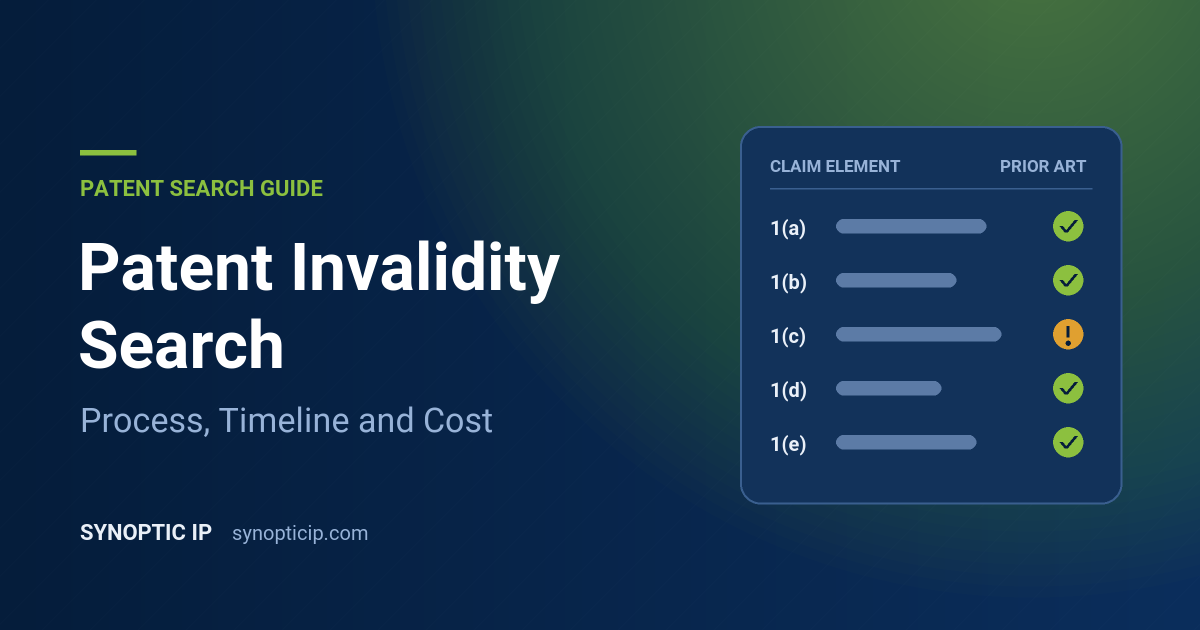
A patent invalidity search looks for prior art that can be used to challenge the claims of a granted patent. It is usually commissioned when a company has been sued for infringement, when an IPR petition or an EPO opposition is being prepared, or when a blocking patent turns up before a product launch.
The search is narrow in one respect and wide in another. It targets a fixed set of claims and a fixed cut-off date, but it has to cover patents and non-patent literature from anywhere in the world.
This guide explains what an invalidity search is, when it is needed, how it is carried out, what the report contains, how long it takes and what it costs.
What is a patent invalidity search?
A patent invalidity search is a search for prior art, published before the priority date of a patent, that discloses what the patent claims. A single document that discloses every element of a claim anticipates that claim. Two or three documents that can be combined may show that the claim was obvious. The results are used to challenge the patent.
The same search is also called an invalidation search or a validity search.
It is different from a freedom to operate search, which checks whether a product infringes the in-force claims of another party. In an invalidity search the claims are already granted and fixed, so every claim element has to be found in the earlier prior art.
When is an invalidity search needed?
The most common trigger is an infringement suit. The defendant uses the search results to prepare invalidity contentions and to decide between litigation and settlement.
Attorneys also commission the search before filing an IPR or PGR petition in the US, and before an opposition or a UPC revocation action in Europe.
Outside disputes, the search is used in licensing negotiations and due diligence, where relevant prior art for invalidity changes the value of a patent. Another common trigger is an FTO search that identifies a single blocking patent before a product launch.
When only an early indication is needed, a shorter knock-out validity search may be sufficient.
What kind of prior art can invalidate a patent?
Any document made public before the priority date can count, whatever its language or country of origin. In practice the references fall into three groups:
- Patents and published applications from any patent office.
- Non-patent literature (NPL), such as journal articles, conference papers, technical standards, product manuals, theses and archived web pages.
- Evidence of prior public use or sale, which some proceedings accept and others do not.
In software, telecom and medical devices in particular, the product was frequently available before the patent application was filed. For that reason the NPL search deserves the same effort as the patent search.
A reference is strong when it meets four tests:
- Date. It is earlier than the priority date, and the date can be proved.
- Coverage. It discloses several claim elements in one document. One reference that covers most of a claim is more useful than five references that each cover one element.
- New to the examiner. Prior art already considered during prosecution is more difficult to rely on.
- Public availability. A manual or a thesis helps only if it can be shown that the public could obtain it before the priority date.
Which deadline applies to the search?
The proceeding decides which prior art can be used and how much time is available. The table below covers four common proceedings (rules as checked in October 2026).
| Proceeding | Prior art that can be relied on | Deadline for the filing |
|---|---|---|
| Inter partes review (USPTO) | Patents and printed publications only | Petition within 1 year of being served with an infringement complaint |
| Post-grant review (USPTO) | Wider grounds, including prior public use or sale | Petition within 9 months of grant |
| EPO opposition | Anything made available to the public, in writing, orally or by use | Notice of opposition within 9 months of the mention of grant |
| US district court litigation | Any prior art under sections 102 and 103 | Invalidity contentions, on the date in the court’s schedule |
For an IPR, the USPTO accepts only patents and printed publications, so an IPR prior art search is limited to these from the start. The petition must also be filed within one year of the complaint being served. The EPO allows nine months from the mention of grant for an opposition.
The proceeding and its deadline should be settled before the search is scoped, because they decide both the usable prior art and the delivery date.
How is a patent invalidity search conducted?
A professional patent invalidity search follows five steps.
Step 1: Analyse the claims and the prosecution history
The searcher starts with the asserted claims, the specification and the prosecution history. The prosecution history shows the prior art already considered by the examiner, the arguments made by the applicant and the amendments made to the claims. These amendments usually indicate the claim elements on which the patent was allowed, and most of the search effort is directed at those elements.
Each independent claim is then divided into key features. Every reference found later is checked against these key features.
Step 2: Agree the search plan
Before the full search, the search firm should share a search plan: the key features, the preliminary search strings with hit counts, the classifications and the date cut-off. This is the point at which the attorney can change the key features or add search terms. A difference in how a claim term is understood is easiest to correct at this stage.
Relevant prior art is often missed because of small variations in keywords. A term written as “Wi-Fi” in one document appears as “WiFi” or “Wi Fi” in another. Product codes are written with and without hyphens. Trade names and abbreviations are used in place of the technical term. Operators, wildcards and proximity operators pick up these variants, and the strings keep changing during the search as new terms turn up in the results.
Step 3: Search patents and non-patent literature worldwide
Patent searching is done in commercial databases such as Questel Orbit, PatSeer or Derwent Innovation, which cover the major patent offices. For some technologies a large share of the prior art is in Chinese, Japanese, Korean or German. Those documents are best searched in the original language, with machine translation as a second check.
NPL is searched separately, in scientific databases, the archives of standards bodies, product documentation and web archives.
A careful searcher also follows the forward citations and the patent family of each relevant reference. Related documents often describe the same subject matter in different words, and sometimes one of them has an earlier date.
Step 4: Screen and rank the references
Every hit is screened against the key features, and the remaining references are ranked using the four tests described above. Each one is then assessed twice: for anticipation on its own, and for obviousness in combination with other references.
Step 5: Map the claims to the prior art
For the most relevant references, each claim element is mapped to the exact paragraph, figure or table that discloses it. The result is an invalidity claim chart.
Where a claim element is not clearly disclosed, the chart should say so. A typical comment reads: “Element 1(c), the wireless transmitter, is not clearly disclosed in this reference.” Comments like this show the attorney the weak points of a reference before it is relied on.
What does an invalidity search report contain?
A complete invalidity search report usually contains:
- The search plan, with key features, search strings, classifications and databases used.
- The most relevant prior art references, ranked, with publication and priority dates.
- Invalidity claim charts mapping each claim element to the text of the reference.
- Comments on each reference, including the charts where the mapping is weak.
- Copies of the NPL documents.
- The complete search history.
Some references have no clear publication date. A careful report gives the date that can be verified, such as the filing date, and flags it. This sample invalidity search report shows a typical format.
On large litigation projects the charts are often delivered in batches, so that feedback on the first batch can be applied to the rest.
The report provides the prior art and the mapping. Whether the claims are invalid is a legal opinion, which remains with the patent attorney.
How long does an invalidity search take?
Most invalidity searches take one to three weeks once the scope is agreed.
A single patent with 1–2 independent claims in a narrow technology takes the least time. Several patents, a crowded technology, additional languages, a detailed NPL search or claim charts for every claim take longer. Many search firms offer expedited delivery when a filing deadline is close.
Occasionally the early results bring up terminology that the first search strings did not cover. The search then takes longer, and a revised delivery date should be agreed as soon as that is clear.
How much does a patent invalidity search cost?
Prices vary widely with the scope. As a reference point, invalidity searches at Synoptic IP cost between USD 1,200 and USD 10,000. The table below shows the factors that move the price within a range like this.
| Factor | Lower price | Higher price |
|---|---|---|
| Claims in scope | 1–2 independent claims | Many independent and dependent claims |
| Technology | Narrow mechanical field | Crowded software, telecom or biotech field |
| Coverage | Patents, English only | Patents and detailed NPL, several languages |
| Deliverable | Ranked references with comments | Claim charts for every claim |
| Timing | Standard | Expedited |
On large litigation projects, invalidity claim charts are usually priced per chart. This keeps the budget predictable when further patents and asserted claims are added during the project.
It is worth asking for a fixed price and a delivery date before the search starts.
What does a search firm need to start?
The patent number and the claims in question are enough for a quote. If only certain claims are asserted, say which ones, since a search on all claims costs more and takes longer.
Three more items help:
- The prosecution history, if it is already at hand, so that art cited by the examiner is not searched again.
- Any prior art already identified. It is used to refine the search strings.
- The date cut-off to be applied, especially where the priority claim is disputed.
Commission a patent invalidity search
Synoptic IP conducts invalidity searches and prepares invalidity claim charts for law firms and in-house IP teams. For a fixed price and a delivery date, send the patent number, the claims in question and the deadline.
Request a quote for an invalidity search
Frequently Asked Questions
What is the difference between a validity search and an invalidity search?
They are the same search, requested by different parties. A patent owner requests a validity search to test their own patent before asserting or licensing it. A challenger requests an invalidity search to identify prior art against the patent of another party. The methodology, the databases and the report are the same in both cases.
How is an invalidity search different from a patentability search?
A patentability search is conducted before filing, against an invention disclosure, to check whether the invention is new. An invalidity search is conducted after grant, against the exact wording of the claims, with the priority date as the cut-off. It is more detailed, covers non-patent literature more heavily and usually ends in claim charts.
Can non-patent literature invalidate a patent?
Yes. A journal article, conference paper, technical standard, product manual or thesis counts as prior art if it was publicly available before the priority date of the patent. In practice the difficult part is proving that date. A good search report therefore records where each document was published and when.
Can an expired patent be used as prior art?
Yes. A patent or published application counts as prior art based on its filing and publication dates, whether or not it is still in force. Expired, lapsed and abandoned documents are searched in the same way as patents in force, and they can be the closest references in a mature technology.
Can a patent invalidity search be used for an IPR petition?
Yes, if the scope is set for an IPR from the start. An IPR can rely only on patents and printed publications, so the search is limited to those. The claim charts are prepared in a form the attorney can adapt for the petition, and the one-year filing deadline decides the delivery date.
What happens if the search does not find strong prior art?
The report states this clearly. It still lists the closest references, comments on the claim elements that each reference does not disclose, and gives the complete search history showing what was covered. This record helps the attorney weigh settlement, licensing or a design-around against a validity challenge.
Can claim charts be prepared for prior art that is already known?
Yes. If the references have already been identified, invalidity claim charts can be prepared from them, with each claim element mapped to the paragraph that discloses it. The charts should also mention any element where the mapping is weak, so that no argument is built on a reference that does not disclose the feature.