
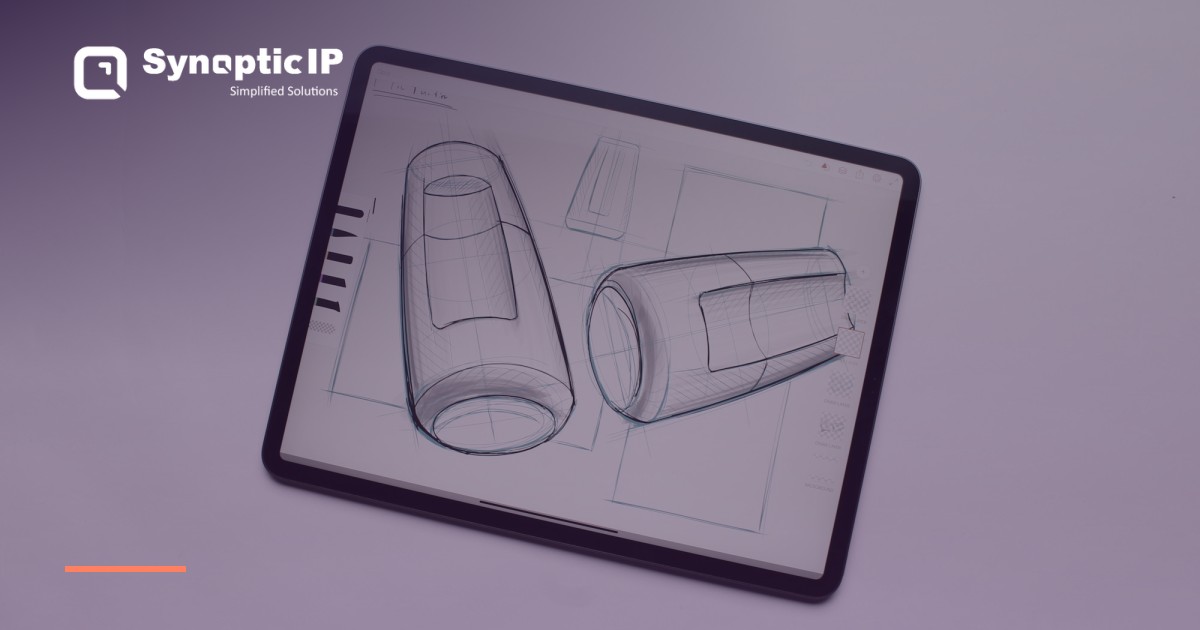
A design FTO search is a freedom to operate (FTO) search on the appearance of a product. It checks whether a shape or surface decoration can be used in a market without infringing a design patent or registered design in force there. Like any freedom to operate search, it is usually run once the design is fixed and before money is spent on tooling.
The search compares pictures rather than claim wording. The searcher screens drawings and photographs of earlier designs for any that look too close to the new product. The general process is set out in the freedom to operate search guide, and this article covers what changes for a shape.
What a design FTO search covers
A design FTO search covers the design rights enforceable where the product will be made, sold or imported. The main ones are US design patents, registered EU designs, national registered designs such as UK registered designs, and international registrations under the Hague System. Registered EU and UK designs both last up to 25 years, renewed every 5 years.
A utility patent can also claim a shape that does a technical job, such as a clip or grip profile. Full clearance therefore pairs the design search with a standard FTO search on the functional features. Three-dimensional trade marks and trade dress are a further layer.
How infringement is judged
Each result is ranked against the comparison test of the jurisdiction where it is in force.
| Right | Comparison test | Maximum term |
|---|---|---|
| US design patent | Ordinary observer: substantially the same to a purchaser, judged against the prior art | 15 years from grant |
| Registered EU design | Informed user: a different overall impression or not | 25 years from filing |
| Unregistered EU design | Same test, but only copying infringes | 3 years from first disclosure in the EU |
The US test dates from Gorham v White (1871). In Egyptian Goddess (2008), the Federal Circuit sitting en banc held that the ordinary observer views the differences in the context of the prior art. In both systems, a design in a crowded field has narrow protection, so small differences can matter.
How a design FTO search is carried out
The method uses the tools of a design patent search, but reads only rights in force or pending in the chosen countries.
- The searcher works from drawings, CAD renders or photographs showing every side of the product.
- The product is placed in its Locarno class, the international classification for industrial designs. The United States Patent and Trademark Office (USPTO) also uses its own 33 design classes (D1–D34 and D99).
- Class searches are combined with keywords and, where offered, image search.
- The closest results are compared view by view.
- Each remaining right is checked for owner, status and expiry in every country of interest.
The free WIPO Global Design Database covers many national and regional registers and the Hague registrations. Reading the views also matters, because the parts of a US design drawn in broken lines are not claimed, as the guide to design patent drawings explains.
Rights a design FTO search cannot see
Some rights are invisible on the search date, so a clean register search is not the whole answer.
- Pending US design applications. Those filed directly at the USPTO are not published before grant (35 U.S.C. 122(b)(2)(A)(iv)).
- Deferred EU designs. Publication can be deferred for up to 30 months from filing or priority, says the European Union Intellectual Property Office (EUIPO).
- Unregistered rights. Neither the unregistered EU design nor UK unregistered design right appears in a register. The UK right lasts 15 years from the end of the year of creation or 10 years from the end of the year of first sale or hire, whichever ends first (CDPA 1988, s 216).
These gaps are usually covered by a review of competing products on sale and a further check shortly before launch.
When a close design is found
The options are a change of appearance, a licence, a validity challenge, a later launch or leaving out the country concerned. A redesign has to alter the overall impression, and one changed detail is often not enough.
Cost of a design FTO search
FTO searches at Synoptic IP cost USD 800–4,000 (checked November 2026). The price of a design FTO search generally depends on the number of products and countries, and on whether a market review is included.
Commission a design FTO search
To receive a proposal for a design FTO search, send us the product views and target countries through our FTO search service page.
This guide is general information and is not legal advice.
Frequently Asked Questions
Is a design patent search the same as a design FTO search?
No. A patentability search looks at all earlier designs, whatever their status, to judge whether a new design can be registered. A design FTO search reads only rights in force or pending in the countries of interest and asks whether the product would infringe them.
How long does a US design patent last?
A US design patent lasts 15 years from grant for applications filed on or after 13 May 2015, under 35 U.S.C. 173. Older applications carry a 14-year term. No maintenance fees are payable on a design patent, so its term does not depend on renewal payments.
Can a utility patent cover the shape of a product?
Yes. A utility patent can claim a shape that performs a technical function, such as a profile that improves grip or a contour that guides air flow. A search of design registers will not find such patents, so full clearance adds a standard FTO search on the functional features.
Do unregistered designs matter before a product launch?
Yes, in the EU and the UK. Unregistered design rights arise without any filing, so no register shows them. They protect against copying rather than independent creation, and a review of competing products on sale is the usual way to reduce the risk before a launch.
What does a design FTO report include?
A design FTO report usually lists the relevant rights with their images, owners, legal status and expiry dates by country. It adds side-by-side views of the closest designs, a risk ranking and a record of the classes and strings searched, so the search can be updated when the product changes.